
Home / Blog / Shopify vs. Magento
Shopify vs. Magento: Which Platform Actually Fits Your Brand
The answer is rarely the one you read online. For the vast majority of D2C shops between €1M and €20M revenue, Shopify Plus is the better economic decision. Magento remains relevant — but for a narrower profile than most agencies will admit.
Two systems, two philosophies
Magento is an open-source platform promising maximum control. You host yourself, you develop yourself, you maintain yourself. Adobe Commerce, the paid version, removes part of the infrastructure burden, but the architecture remains: a heavy, modular system that cannot reasonably be operated without a dedicated dev team.
Shopify takes the opposite path. You get a finished, hosted platform with clear boundaries — and within those boundaries a speed Magento will never reach by design. Less freedom, less maintenance, faster time-to-market. The two philosophies aren't good or bad; they address different problems.
What it actually costs
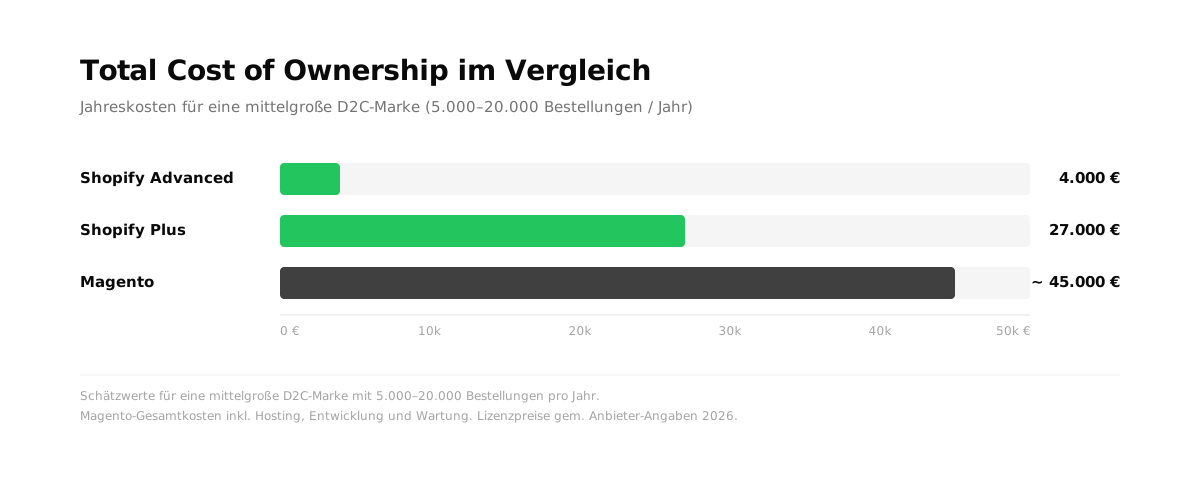
This is where the discussion gets dishonest. Magento Open Source is „free" — that's in every comparison. The reality for a shop with serious traffic: €400–800/month for hosting, a dedicated developer or agency (€3,000–6,000 monthly), security patches, extension licenses, updates. Total cost of ownership lands at €30,000–60,000 per year quickly. Adobe Commerce adds on top: license costs start around €22,000 annually, open-ended upward.
Shopify Advanced costs around €4,000/year. Shopify Plus starts at $2,300/month — roughly €27,000 annually, usually including the infrastructure you pay for separately on Magento.
Where Magento still wins
Magento has clear strengths worth acknowledging. Complex B2B scenarios with customer-specific price lists, multi-step approval processes, and deeply integrated ERP connections map cleaner on Magento. If you're managing 100,000 SKUs with real variant configurators, Shopify hits real limits — Shopify caps variants per product, and the architecture isn't built for extreme catalog depth.
Data sovereignty is another argument. If you're regulated to keep all customer and order data on your own servers in Germany, Magento gives you more room. For certain pharma, finance, or B2B wholesale cases, that's a real decision criterion — for a fashion or beauty brand, practically never.
Where Shopify is the better system
A checkout that converts
The Shopify checkout converts measurably better. Shopify has poured billions into optimizing it — you get the result at no additional cost.
App ecosystem
The app ecosystem covers 95% of what mid-sized shops actually need. New sections, landing pages, campaign pages — built in hours instead of weeks.
Performance & maintenance
An average Magento setup struggles with load times that Shopify beats without tuning. Plus: no patch day, no 3 AM security updates, no extensions breaking after an update.
The migration reality
Anyone migrating from Magento to Shopify almost always underestimates three things. First, URL structure: Magento URLs follow a different logic — you need a full 301 redirect matrix, or you lose rankings. Done in two days if planned properly — or six months if not.
Second, custom modules. Every special logic developed on Magento either has to be replaced by a Shopify app or rebuilt. Sometimes there's no 1:1 equivalent — then the answer is to simplify the process, not clone it. Uncomfortable, but usually a win.
Third, time. The pure technical transfer would be feasible in six to ten weeks — the lived reality of a mid-sized brand is three to six months. The difference isn't in development but in feedback loops: Marketing wants design polishing, Operations checks order and return flows, IT signs off on ERP and PIM interfaces, plus UAT with real data. Each round eats two to four weeks.
Which system for whom?
Stay on Magento if you run serious B2B with individual pricing and approval logic, maintain a catalog with real configurators, or are regulated to self-host. For everything in between, Shopify Plus exists.
Considering a move from Magento to Shopify? My Shopify Migration page covers my process, common pitfalls, and concrete timelines.
Frequently asked questions
How much does Magento really cost per year?
For a mid-sized shop, Magento Open Source TCO lands at €30,000–60,000 annually (hosting, development, maintenance). Adobe Commerce adds around €22,000 in license costs — so €50,000–100,000 per year in reality.
Is switching from Magento to Shopify worth it?
In most cases yes, provided you're not one of the exceptions (heavy B2B, extreme catalog depth, regulatory hosting requirement). The savings on running costs alone typically pay back the migration within twelve to eighteen months.
How long does a Magento-to-Shopify migration take?
Realistically three to six months for a mid-sized brand. The timeline depends less on technical transfer — feasible in six to ten weeks — than on feedback loops with Marketing, IT, and Operations, ERP and PIM interface sign-offs, and UAT with real data. Anyone wanting completion in two months must radically reduce scope.
Is Shopify Plus suitable for large B2B shops?
With Shopify B2B, Plus now covers most standard requirements: company accounts, price lists, net-terms payment. For very individual approval workflows or deeply integrated ERP scenarios, Magento remains more flexible.

Facing a platform
decision?
I help you honestly evaluate whether Shopify Plus, Magento, or something in between fits your brand — without agency bias.